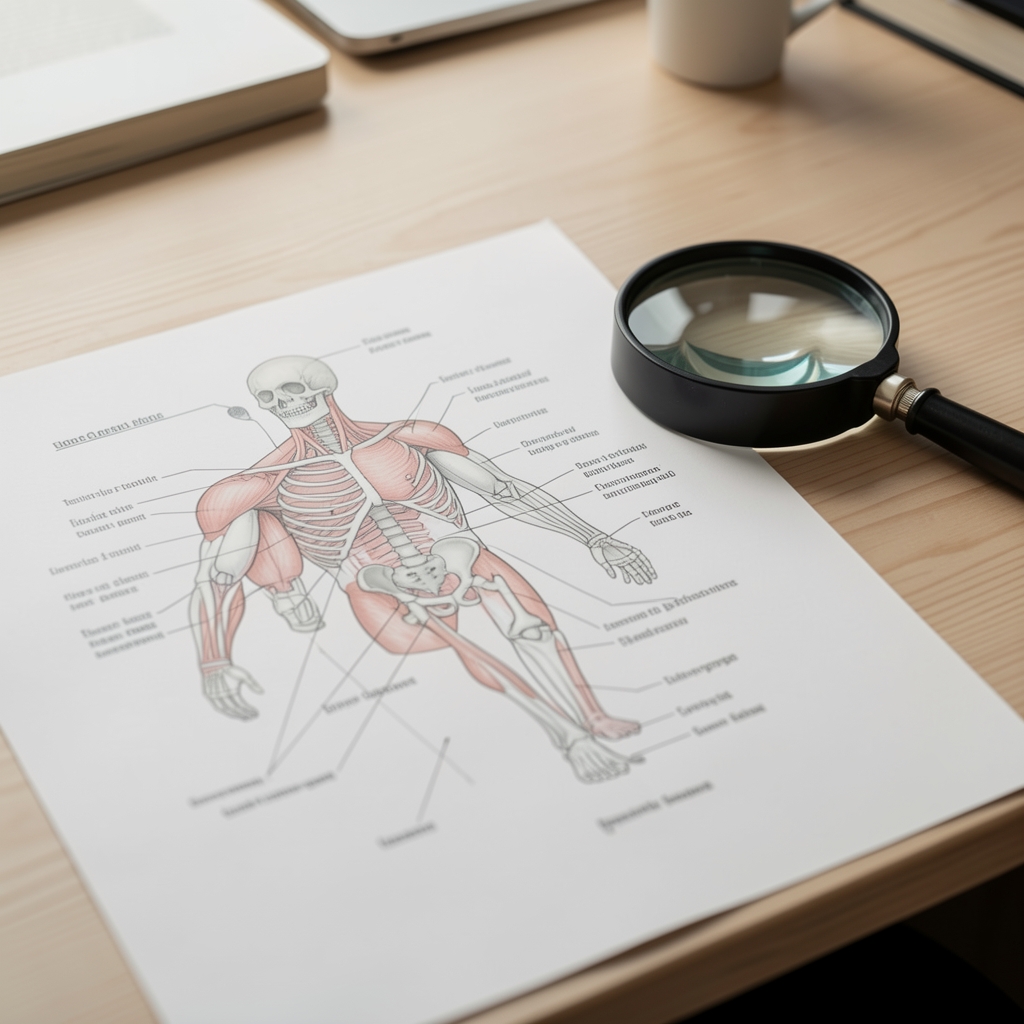
What Are the Pelvic Floor Muscles?
The pelvic floor is a layered group of muscles, ligaments, and fascial tissues that form the base of the pelvic cavity. In men, this muscular complex spans the underside of the pelvis from the pubic bone at the front to the coccyx at the rear, creating a structured hammock-like base that provides support to the organs situated above it. The musculature is not a single uniform layer but rather a series of overlapping structures, each with distinct anatomical properties and functional characteristics.
Three muscles are most frequently cited in anatomical descriptions of the male pelvic floor: the levator ani, which comprises the pubococcygeus, iliococcygeus, and puborectalis; the coccygeus; and the external sphincter muscles associated with the urethra and anal canal. Together these structures form a coordinated functional unit that operates largely below the threshold of conscious awareness during ordinary daily activity.
Structural Position Within the Pelvis
Understanding the structural position of the pelvic floor requires some sense of how it relates to adjacent systems. Above the pelvic floor sit the bladder, the lower section of the large intestine, and the prostate gland. The pelvic floor provides a supporting surface for these organs and works in coordination with surrounding muscular systems including the abdominal muscles, the diaphragm, and the deep spinal muscles that are collectively referred to in movement literature as the core.
This positioning means that changes in intra-abdominal pressure, whether generated by lifting, coughing, or postural shifts, are transmitted to and through the pelvic floor. The floor responds by adjusting its tension in a reflexive manner. The degree to which this reflex functions smoothly and consistently is what physiotherapy literature generally refers to when discussing pelvic floor tone.
The Concept of Tone
In the context of musculoskeletal discussion, tone refers to the baseline resting tension maintained by a muscle or group of muscles. For the pelvic floor, appropriate tone means a resting state that is neither excessively tense nor insufficiently engaged. Discussions in physiotherapy literature describe a spectrum ranging from hypertonic, meaning overly contracted and resistant to full relaxation, to hypotonic, meaning lacking sufficient baseline engagement.
Both ends of this spectrum are discussed in the literature as potentially associated with functional limitations in posture, movement coordination, and related areas of daily physical function. The concept of optimal tone is therefore not simply about strength but about range and responsiveness.
Functional Roles in Everyday Life
Beyond the structural support role, the pelvic floor contributes to a range of functional activities in daily life. These include the maintenance of continence for both the bladder and bowel, the coordination of trunk stability during standing and movement, the management of pressure changes during physical exertion, and the support of posture during prolonged sitting or standing. In movement science literature, the pelvic floor is often discussed alongside the transverse abdominis and diaphragm as part of a deep stabilising system that activates in anticipation of limb movements.
In functional movement science, the pelvic floor is characterised not as an isolated structure but as a dynamic participant in the body's broader system of load transfer and postural regulation.
Why the Subject Gains Particular Relevance After 35
The age of 35 appears in much of the general literature as a point at which men's physical awareness and exercise habits may shift. Changes in activity levels, occupational posture, and the gradual natural changes associated with ageing are all discussed as factors that may affect pelvic floor function over time. The literature notes that sedentary work, reduced physical variety, and accumulated postural habits are among the contextual factors relevant to pelvic floor tone in men of this age group.
This is not an argument for urgency or alarm. Rather, it suggests that the pelvic floor, like other muscular systems, is subject to the same principles of use-dependence that govern general physical conditioning. Awareness of its role and function forms part of a broader picture of informed physical self-knowledge.
The Pelvic Floor in Relation to Core Systems
One of the more notable conceptual developments in functional movement literature over recent decades has been the incorporation of the pelvic floor into discussions of core stability. Historically, popular understandings of the core focused primarily on the superficial abdominal muscles. More recent academic and applied literature has drawn attention to the deep musculature, including the pelvic floor, as functionally integral to spinal support and load management.
This reframing positions pelvic floor awareness not as a niche concern but as part of a general approach to physical literacy. Understanding how these muscles contribute to trunk stability, breathing coordination, and pressure regulation gives a more complete picture of how the body functions as a system rather than as a collection of independent parts.